
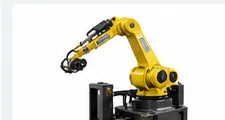
When robotics makes sense
Use robotics when fixed nozzles would require too many stations, when paths must follow a complex surface, when recipes change frequently or when a repeatable dwell pattern matters to final quality.
For simple cylindrical or flat parts, a turntable or linear motion system may be a better value. We compare both approaches before recommending a robot.
Typical robotic cell architecture
Six-axis industrial robot with protected dress package and blast nozzle or part gripper.
Enclosed blast chamber with interlocked access and service-friendly maintenance points.
Turntable, positioner or fixture designed to expose critical part surfaces.
PLC/HMI controls for recipes, cycle status, alarms and maintenance diagnostics.
Media delivery, reclaim and dust collection sized for the duty cycle.
Production outcomes
Consistent tool paths and dwell times make the process easier to validate and reproduce. Robotic cells can also reduce direct labor and let operators focus on loading, inspection and upstream/downstream work.
Frequently Asked Questions
Should the robot move the nozzle or the part?
It depends on payload, part geometry, blast hose routing and required angles. Nozzle manipulation is common, but rotating or presenting the part can simplify the cell.
Can the robot run multiple part recipes?
Yes. Recipes can select robot programs, motion positions, blast time, pressure setpoints and auxiliary equipment states.
Can we use FANUC, ABB, KUKA or Yaskawa?
System architecture can be engineered around major industrial robot platforms based on plant standards, payload, reach and support preferences.