
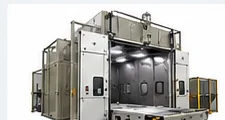
Room automation building blocks
Robotic or multi-axis nozzle motion.
Powered carts, tracks, conveyors or monorails.
Large-capacity rotary positioners.
Automated doors and safety zoning.
PLC/HMI sequencing and production recipes.
Hybrid manual and automatic operation
A large blast room may still need manual capability for prototypes, repair work or unusual geometry. Hybrid designs can preserve that flexibility while automating the repeatable production family.
Coordinate ventilation and recovery early
Room airflow, collector capacity and abrasive recovery have to support the automated cycle. Increasing blasting duty without checking those systems can move the production bottleneck somewhere else.
Frequently Asked Questions
Can an existing Clemco blast room be automated?
Potentially. Structural condition, room size, ventilation, recovery, access and safety system requirements should be evaluated first.
Can large parts be rotated automatically?
Yes. Powered turntables, headstock/tailstock positioners and carts can be integrated depending on part weight and geometry.
Can a robot operate inside a blast room?
Yes, with appropriate protection, reach, hose management, maintenance access and a safety architecture designed for the application.